Categories
CFP

Key ideas and concepts of Digital Humanities 26 – 28 Oct 2015


corpora list

Conference announcement: Key ideas and concepts of Digital Humanities
26 – 28 October 2015

The conference “Key ideas and concepts of Digital Humanities” which is supported by the Deutsche Forschungsgemeinschaft (DFG) is going to be hosted at Technische Universität Darmstadt from 26 to 28 October 2015. All colleagues and students interested in the Digital Humanities are invited; participation is of free of charge. The conference registration is open now at:

http://www.dh-concepts.tu-darmstadt.de

The hosts are Michael Sperberg-McQueen, who holds the KIVA International Visiting Professorship for Interculturality and Andrea Rapp, Professor for Computer Philology at Technische Universität Darmstadt as well as Sabine Bartsch and Michael Bender, all members of the working group DHDarmstadt.

Conference theme

The role of the Digital Humanities is currently discussed controversially with a view of both the present and the future. It seems a truism that we need to incorporate the past, if we are to conduct a fruitful discussion of the future. The basis for the present and future role of the field are the key ideas and concepts from which it has evolved. A reappraisal of the history of ideas not only shows the essence of the field, but also highlights the potential it has to offer for the humanities and other, related fields. The interaction of computational concepts with ideas from the breadth of humanities-disciplines has the potential to generate more than the sum of the parts. Since the inception of the field formerly known as humanities computing, new methods were developed and new insights gained. Frequently, interdisciplinary border crossings constitute key moments in which new ideas and concepts emerge. The compilation of a history of ideas of the Digital Humanities is possible, and it is necessary. With this conference, we aim to chart the history of the digital humanities by focusing on a discussion of the key ideas and concepts and the associated key-moments in the development of the field.
Whether early pioneering achievements such as the cooperation between Father Roberto Busa and IBM since the late 1940s; Vannevar Bush’s essay “As We May Think” describing the landmark idea and design for the Memex; younger milestones such as the establishment of the Text Encoding Initiative (TEI), or the conception of the eXtensible Markup Language (XML) – examples of key ideas of the DH abound.
The event is going to be centred around experts from different areas of the Digital Humanities, each presenting a paper on a key idea or a moment in their research area. The conference will help to identify the most important achievements of the field and discuss their origins and position, their impact and development or possibilities for development.

Conference dates: Monday, 26 October to Wednesday, 28 October 2015
Conference organisation: Sabine Bartsch, Michael Bender
Team DHDarmstadt
Institut für Sprach- und Literaturwissenschaft
Technische Universität Darmstadt
Contact: dh-concepts@linglit.tu-darmstadt.de
Conference website: http://www.dh-concepts.tu-darmstadt.de

Categories
corpus linguistics

GraphColl building and exploring networks of linguistic collocations @TonyMcEnery


GraphColl is a tool for building and exploring networks of linguistic collocations. It was developed at CASS at Lancaster University in 2014-15.

The concept and design of GraphColl is covered in Brezina et. al. (2015), published at IJCL.

Categories
Humour

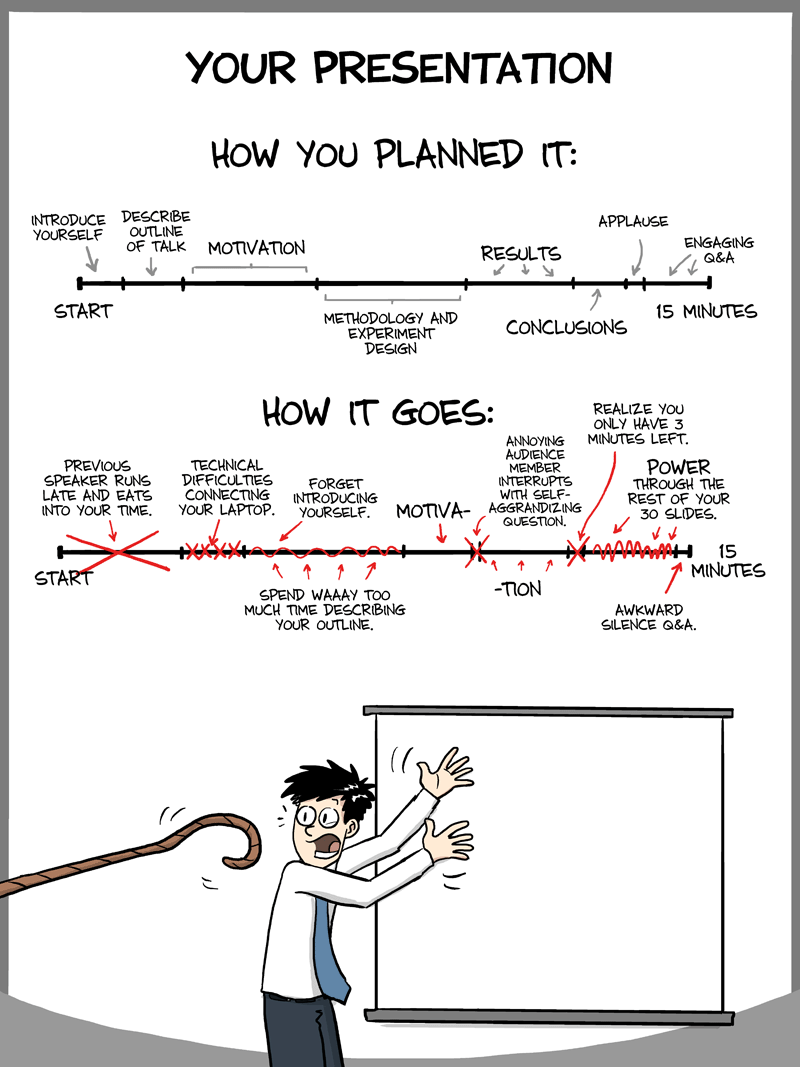
@phdcomics Your conference presentation

Find more PhD comics here: http://www.phdcomics.com

Categories
analysis of language applied linguistics journals

Australian Review of Applied Linguistics Vol 38, 1 out

Access this issue of the Australian Review of Applied Linguistics

(ISSN: 1833-7139) The Australian Review of Applied Linguistics (ARAL) is the journal of the Applied Linguistics Association of Australia (ALAA). The aim of the journal is to present research in a wide range of areas, but in particular research that is relevant to the particular region of the world that it covers. The journal aims to promote the development of links between language related research and its application in educational, professional, and other language related settings. Areas that are covered by the journal include first and second language teaching and learning, bilingualism and bilingual education, the use of technologies in language teaching and learning, corpus linguistics, discourse analysis, translation and interpreting, language testing, language planning, academic literacies and rhetoric.

Categories
CFP conferences corpus linguistics Corpus Linguistics Conference 2015

Corpus Linguistics #cl2015: notes and pics

Corpus Linguistics Conference 2015, University of Lancaster, UK

Thanks to @TonyMcEnery, @HardieResearch and everybody at @UCREL_Lancaster for organizing a wonderful conference.

Abstract book download:

Adobe-PDF-Document-icon

A selection of talks and personal notes:

Learner corpus research plenary #cl2015

Multi-dimensional analysis of oral proficiency interviews #cl2015

Non-obvious meaning in CL and CADS #cl2015

Representation of benefit claimants in UK media #cl2015

Tono Linguistic feature extraction #cefr #cl2015

Language learning theories underpinning corpus-based pedagogy #cl2015

MA of L2 learner English

And some pics:


IMG_20150730_215443

Robert Poole (left)

IMG_20150730_215522

Ricardo Jiménez

IMG_20150730_215840


IMG_20150722_210050

Carlos Ordoñana (left)

IMG-20150723-WA0015

Lynne Flowerdew

IMG-20150723-WA0006

Carlos Ordoñana (left) and Yukio Tono (right)

IMG-20150724-WA0009

Discussing the representation of immigrants in the context of the LADEX project.

IMG-20150724-WA0010

Discussing the representation of immigrants in the context of the LADEX project.

IMG-20150723-WA0006

Carlos Ordoñana (left) and Yukio Tono (right)

IMG-20150723-WA0009

Yolanda Noguera and John Flowerdew

IMG-20150723-WA0011

Yukio Tono (middle)

IMG_20150730_215950

Yolanda Noguera and Michael Barlow


Categories
CFP corpus linguistics language analysis Language and the law

Cardiff language and Law: Symposium Nov 2015 & Corpus Approaches to Public & Professional Discourse


From the Forensic Linguistics e-mail list

::::::::::::::::::::::::::::::::::::::::::::::::::::::::::

Symposium on “Expertise in Language and Law” will take place on Friday 27th November 2015.

This Symposium is part of the Advanced Research Residency in Language and Law which takes place at Cardiff University from October to December this year. The full program

me of events is at: http://blogs.cardiff.ac.uk/call/.

The Symposium is followed, on Saturday 28th November, by a Conference entitled “Corpus Approaches to Public and Professional Discourse” (http://blogs.cardiff.ac.uk/corpus/).