These two photos taken from atlasofwonders.com
Most of the shooting took place in Alberta.


This is taken from http://www.telegraph.co.uk

These two photos taken from atlasofwonders.com
Most of the shooting took place in Alberta.
This is taken from http://www.telegraph.co.uk
Infografía procedente de la web de Alfredo Vela.
URL original: https://alfredovela.files.wordpress.com/2016/01/espanol-en-el-mundo-infografia.jpg?w=1306&h=4336


CALL FOR PAPERS
BAAL / Cambridge University Press Applied Linguistics Seminar Programme 2015-2016 and COST Action IS1306
New Speakers in a Multilingual Europe: Opportunities and Challenges
New plurilingual pathways for integration: Immigrants and language learning in the 21st Century
Heriot-Watt University, Edinburgh, 26th & 27th May 2016
The 21st Century is witnessing increased discussions on immigration in local, national and international contexts. The aim of this seminar is to bridge the study of language and immigration and consider the extent to which immigrants learning new languages (which include learning majority, minority and/or heritage languages) may contribute to a more comprehensive and plurilingual view of integration today.
The proceedings will be directed by key themes and objectives as follows:
• What are the opportunities and challenges for immigrants who learn new languages?
• To what extent do immigrant speakers challenge current conceptions of integration, cohesion and citizenship?
• Which steps or initiatives could facilitate a more comprehensive view of integration, cohesion and citizenship in national and minority language contexts?
Confirmed plenary speakers:
Professor Máiréad Nic Craith (Heriot-Watt University)
Professor Alison Phipps (University of Glasgow)
Round table discussion: Immigration in the 21st century: language, integration and citizenship
Professor Diarmait Mac Giolla Chríost (Cardiff University)
Professor Bernadette O’Rourke (Heriot-Watt University)
Dr Cassie Smith-Christmas (University of the Highlands and Islands)
Workshop: Immigrants, integration and multilingual practices in the UK
Ms Mirona Moraru (Cardiff University)
Fee: This is a free event and lunch will be provided on both days
Please submit an abstract of no more than 350 words (including references) by 29th February 2016 to baalcupseminar2016@gmail.com.
Contact details (name, affiliation and email address) should be included in the body of the email together with the title.
Please also indicate whether you wish to present a paper or a poster. We intend to publish an edited volume based on the seminar papers and therefore encourage participation from those who are in a position to contribute to the volume.

Cambridge Language Sciences Initiative
Speakers: Dr Teresa Parodi (Dept. of Theoretical and Applied Linguistics) and Dr Pascual Perez-Paredes (Faculty of Education)
-Longitudinal corpora of untutored learners
Teresa Parodi, Dept. of Theoretical and Applied Linguistics
-Noun Phrases in Spanish young learners of EFL: insights from the International Corpus of Crosslinguistic Interlanguage (ICCI)
Pascual Pérez-Paredes, RSLE, Faculty of Education, University of Cambridge
Dr Michael Evans, University of Cambridge
Monday 25 January 2016, 17:00-18:30
Faculty of Education, 184 Hills Road, Cambridge, CB2 8PQ, Room GS4.

Talk and Michael Evans’ bio www
Different dimensions of progression: time, trajectory, context, variation and complexity
Different approaches to measuring language progression: global (usually scale-based), atomistic (descriptive and very detailed accounts) & ecological
Rate of acquisition: Demie 2013 study in London Link
Three main conclusions emerged from this study. Firstly, the empirical data suggests it takes approximately five to seven years, on average, for pupils with EAL to acquire academic English fluency. Secondly, the study of EAL and attainment suggests that there is a strong correlation between stage of fluency in English and educational attainment. The results suggest that the percentage of pupils attaining level 4 or above at KS2 and 5+A*-C at GCSE increased, as stage of proficiency in English increased. Pupils in the early stages of fluency performed at low levels, while the results of pupils with EAL who were fully fluent in English far outstripped those of pupils for whom English was their only language. Secondly, the language, ethnicity and attainment data reflect substantial differences in performance between different ethnic groups at the end of key stage 4. Of all the three main ethnic groups, Black African, Indian, Bangladeshi and Pakistani pupils did better in performance compared to the national average. Black Caribbean, Black Other and Mixed White/Black Caribbean pupils are the main underachieving ethnic groups. However, the study argues that none of these ethnic categories are homogenous. A further analysis of the data by language spoken, highlighted the potential of language data to help disaggregate census ethnic categories and give greater insight into the performance of different groups in schools. The study suggests that analysing ethnic group’s performance by language spoken at home and level of fluency in English adds to our understanding of the associations between EAL, language, ethnic background and attainment.
Profile of language development:
Writing: Cameron 2003, Murphy et al. 2015
Reading: Hutchinson et al. 2003, Jang et al. 2013
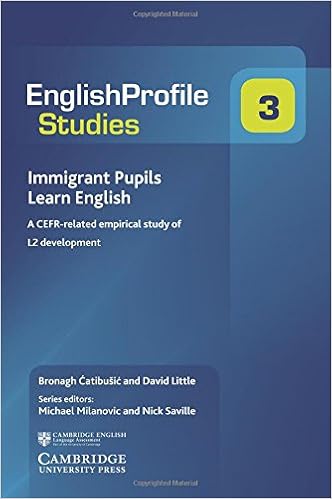
Grammatical functional and interactive dimensions: Catibusic & Little 2014: Immigrant Pupils Learn English (English Profile Studies)
EAL: a pupil whose first language is known or believed to be other than English.
Mixture of profiles in real classroom situations, some learners reject their L1 or question the status of this language in their schools.
2016 Bell Foundation Report by Evans et al.
46 secondary schools in East of England
Two case studies
22 recently-arrived migrant pupils
Language data: 2 open ended writing tasks, 30 minutes, some prompts were provided, 1 year interval
What was analysed? Formal features (word count, spelling mistakes, connectives, tenses, complex sentences.
Comparison of mean scores for correct and incorrect usages in W1 and W2.
70 interviews, 30 min approx
Analyses of the 3 longest turns
Study of conjecture in the language of EAL pupils + Direct/indirect speech