Categories
Scoop.it

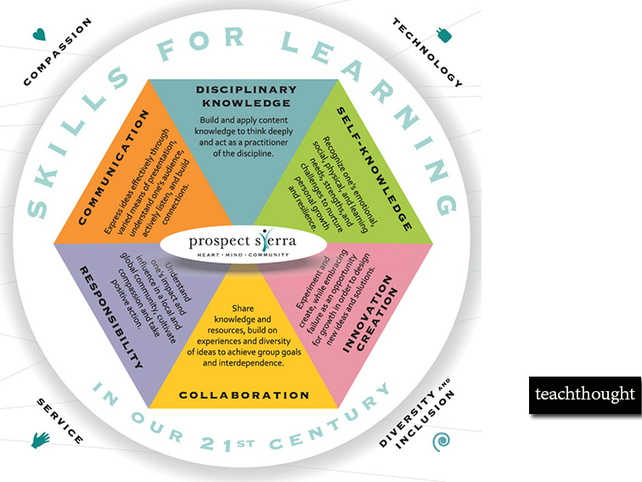
Making Learning Meaningful: 6 Priorities For Whole Learning – TeachThought

“Editor’s Note: We recently discovered the Bay Area’s Prospect Sierra School’s interesting learning model that prioritizes 6 ideas for learning in the 21st century. There is, of course, no single “best” way to pursue “21st century learning”–nor any learning at all for that matter. But seeing the way other inspired educators pursue the idea can teach each one of us a lot. In this model, we appreciate the inclusion of self-knowledge, as well as moving past the idea of content to true disciplinary knowledge–seeing knowledge in context and application.”

Source: www.teachthought.com

Categories
applied linguistics CALL CFP conferences EUROCALL EUROCALL 2014

EUROCALL2014: Full programme available online

EUROCALL2014

Groningen, The Netherlands, 20-23 August, 2014

http://www.eurocall2014.nl/

EUROCALL2014 is the 21st annual conference of EUROCALL, the European
association of computer-assisted language learning. EUROCALL2014 will be
held at the University of Groningen in the Netherlands from 20th to 23rd
August 2014.

We are pleased to announce that the full programme for EUROCALL2014 is now
available online. The main conference programme is presented through
strands on Course Design, Instruction Models, Professional Development,
MALL, Open Education, Telecollaboration, Specific Skills, and many more.

Access the full programme from: http://www.eurocall2014.nl/?page_id=110.

Register now at: http://www.eurocall2014.nl/?page_id=103.

Message distributed by Sake Jager, Local organiser EUROCALL2014

Categories
video www resources

Online video publishing tools

Video Publishing
The best tools and services to capture, edit, publish and distribute video online.

Categories
e-learning Máster

Máster online en Gestión y Producción de e-Learning

La Universidad Carlos III de Madrid abre el plazo de matrícula para el Máster online en Gestión y Producción de e-Learning hasta el día 30 de Junio.

El Máster en Gestión y Producción en e-Learning  tiene como objetivo formar a personas que estén interesadas en la dirección, producción y gestión de enseñanza y aprendizaje asistido por la tecnología en sus diversas formas y variantes, desde una perspectiva interdisciplinar que combina las aproximaciones pedagógicas más innovadoras en el ámbito de la educación (desde el aprendizaje situado al aprendizaje colaborativo) con el uso de las tecnologías más punteras (desde los Cursos Online Masivos Abiertos o Massive Open Online Courses -MOOCs- hasta el aprendizaje apoyado por tecnologías móviles).

El máster va dirigido a profesionales del sector de la formación interesados en aprender y/o actualizarse sobre los últimos avances en la gestión y producción de e-Learning, así como en el diseño y la explotación de este tipo de cursos.

El máster se realiza a distancia siguiendo una metodología inspirada en los MOOCs, basada en vídeos teóricos y ejercicios prácticos que ofrece tres modalidades distintas para adaptarse a cualquier perfil de alumno:

Master en Gestión y Producción en e-learning: 12 módulos de 4 ECTS cada uno y el trabajo fin de Máster de 12 ECTS. Total 60 ECTS.

Especialista en Gestión y Producción en e-learning: Se cursan o bien 9 de los módulos o 6 módulos y el trabajo fin de máster. Total 36 ETCS.

Experto en Gestión y Producción en e-learning: Se cursan 6 módulos. Total 24 ECTS.

Si desea más información sobre los contenidos, precios, créditos, etc. consulte el siguiente enlace o escriba a la dirección de contacto.

Categories
data linked data open data web

Call for Papers: Workshop on Open Data for Education & Learning: The basics and more (OD4edu)

Part of EC-TEL 2014, the 9th European Conference on Technology Enhanced Learning 2014, Graz, Austria

SUBMISSION DEADLINE EXTENDED: New deadline is 7 July, 2014 

LinkedUp is pleased to be hosting a workshop on Open Data for Education & Learning at the EC-TEL 2014. The conference is co-located with i-KNOW 2014 and will be on Tuesday, 16 September 2014.

Overview

The LinkedUp Project is a FP7 Support Action which pushes forward the exploitation and adoption of public, open data available on the Web, in particular by educational organisations and institutions.

This workshop will be directed at members of the education community seeking an introduction to open data and Linked Data and will provide some examples for how they can be used to enhance education and learning resources. The focus will be mostly on the non-functional aspects needed for planning and decision-making for open data projects for education such as: availability, discoverability and reliability of open data resources, as well as licensing and privacy and trust issues related to the re-use of open data. A significant portion of this workshop will be dedicated to assisting educators on how to identify projects and ideas that could take advantage of open data; how to find open data, and how best to evaluate Linked Data and open data that will meet the needs of a specific project-work or learning scenario.

The main research questions the workshop will address are:

·         What are the opportunities for using open data and Linked Data in education?
·         What are the challenges of using open data and Linked Data in education?
·         What are the best selection criteria when evaluating open data?
·         What are the legal and non-technical issues that need to be considered when incorporating open data from the web?
·         What are issues related to trust when using third party data and content?
Workshop topics include but are not limited to:

·         Open data and Linked Data for formal, informal and non-formal education
·         Open data and Linked Data and formative assessment
·         Open data and Linked Data and open learning
·         Open data and Linked Data supporting education in developing countries
·         Open data and Linked Data in cultural applications
Papers Submission

This workshop invites papers and demos (6 pages max. in Springer Format) that deal with the Workshop main topics. In particular, examples of novel and innovative educational applications and scenarios that make use of Linked Data, as well as best practices around the selection criteria for open data resources. Based on the submissions we receive, we will cluster them by themes. Each submission will be evaluated by at least three reviewers. We aim for two or three paper presentations for each main theme we identify after reviewing the submissions. Demos, if available, may be shown during the related presentations.

Papers incorporating the following themes are encouraged:

·         Distance & online learning
·         Informal learning
·         Knowledge management & organizational learning
·         Lifelong learning
·         Non-formal learning
·         Open educational resources (OER)
·         Semantic Web
·         Vocabularies, ontologies & taxonomies for learning & education
Important Dates:

Submissions deadline: 30th June 2014
Deadline extended: 7th July 2014
Author notifications: 25th July 2014
Final versions due: 8th of August 2014
Workshop date: 16th September 2014

Paper submission and review will be managed on EasyChair

Accepted papers published in online proceedings (CEUR).

After the workshop the best papers will be invited to submit an extended version to be included in a special issue to the International Journal of Technology Enhanced Learning (IJTEL) by Inderscience.

Organisers

Michael Lauruhn (first contact), Elsevier, m.lauruhn@elsevier.com

Elisabetta Parodi, Lattanzio Learning Spa, parodi@lattanziogroup.eu

Ivana Marenzi, L3S Research Center, marenzi@L3S.de

Keerthi Thomas, Open University UK, Keerthi.Thomas@open.ac.uk

The CfP is available also at http://linkedup-project.eu/call-for-papers-workshop-on-open-data-for-education-learning-the-basics-and-more/
Categories
evaluación investigación profesores sexenios universidad

El “impact factor” como criterio de selección de profesores e investigadores

Debate enmarcado en el XI foro internacional sobre la evaluación de la calidad de la investigación y de la educación superior

Información: http://www.ugr.es/~aepc/XIFECIESWEB/sesionesdebate.html

Artículos relacionados:

El estilo de pensamiento “factor de impacto”: Un nuevo marco teórico.
pdf en castellano y en ingles (penúltimo artículo de este índice):
http://zl.elsevier.es/en/revista/international-journal-of-clinical-and-355

La tiranía del factor de impacto:
http://www.ifth.es/Pdf/AFTV12N1-02%20Edit%20director.pdf

El significado del índice h.
pdf en castellano y en ingles (último artículo de este índice):
http://zl.elsevier.es/en/revista/international-journal-of-clinical-and-355

Validez y fiabilidad del Researcher ID.
pdf en castellano (séptimo artículo de este índice):
http://zl.elsevier.es/en/revista/international-journal-of-clinical-and-355/sumario/vol-14-num-01-13017522

Ranking 2012 de investigación de las universidades públicas españolas:
http://www.psicothema.com/pdf/4172.pdf

Para más información:
http://www.ugr.es/~aepc/XIFECIESWEB/
http://www.ugr.es/~aepc/XIFECIESWEB/conferencias.html
http://www.ugr.es/~aepc/XIFECIESWEB/sesionesaplicadas.html
http://www.ugr.es/~aepc/XIFECIESWEB/Sede.html