
The Cambridge Undergraduate Quantitative Methods

Freeman Centre, University of Sussex, 27 February 2016
Some of the presentations
____________________
Lee Oakley, University of Birmingham
Some challenges when analysing a Census Corpus
The SexEd Corpus: a census corpus 1950-2014
93,202 words
11-16 year olds
Teenage readership
How are different sexualities presented to British teenagers?
Methodological approach to more qualitative analyses
All analysis is comparison
____________________
Jill Bowie & Sean Wallis, UCL
Investigating changes in structures and collocations, from a treebank to a megacorpus
Corpus: COHA (Davies 2012)
The to-infinitival perfect
80% decrease in use since 1820
402 verb lemmas in order of frequency
Top 30 collocates account for 95% of tokens (top 95% percintile)
Seem, Appear, Say, Ought, Be, Report, Claim
Seeming group
Cognition group
Cognition and saying group
Modality group
Grammatical change tends to be lexically constrained
Benefits of using dual corpora (ICE-GB + COHA)
We need open data to do more with the corpus data
____________________
Taming the beast: getting to grips with a mega corpus.
Chris Turner, Coventry
some / any
Corpus of law reports
____________________
Frequency and grammaticalization in a spoken corpus of Cameroon Pdgin English
Gabriel Ozon, Sheffield
estimated 50% of the population use it
West of Cameroon
Stigmatised status
Pilot study: 30 hours recordings, British Academy
____________________
How to use a nanocorpus. Enriching corpora of interpreting.
Camille Ciollard & Bart Defrancq
Female interpreters hedge more than male speakers
Use of the marker well
____________________
Capturing the zoo: a system for downloading, preparing and managing corpus data from online forums.
Clausia Viggiana & John Williams
Open source tools
Citizen science
To capture and interrogate linguistic data form online CS forums: zooniverse
____________________
How small corpora paradoxically uncovered the nexr quark in corpus studies.
Bill Louw, Coventry & Zimbabwe
Theory of scientific method, William Whewell, Trinity College, Colligation.
Text reads text

Second language education group series, University of Cambridge, 22 Feb, 2016
Back in the 80’s, researching English spoken by non native speakers was considered as a waste of time: what is the point in researching “bad” English?
In the early days, it was language ideologies and attitudes, mutual intelligibility, speech and accommodation theory, and the early world Englishes literature (Kachru, Snith,etc.).
Kachru, The Other Tongue. English across cultures.
The Lingua Franca Core (pronunciation only).
VOICE corpus, Seidlhofer, some common features identified
ELFA corpus, Mauranen
Inherent fluidity (Seidlhofer, 2009)
Not tied to Angliphone cultures
Not restristed to representing their own L1/culture
Hybrid culture practices
Similect speakers, Mauranen (2012)
Definitions of ELF:
English used as a contact language among speakers from different first languages (Jenkins, 2009)
ELF in NOT about establishing a variety, although it continues to be thought so by many (even quoting Jenkins herself).
Celia Roberts: the ELF bubble (June 2013), ELF as being self-contained
Multilingualism research:
Translanguaging, Garcia 2009, Garcia & Li Wei, 2014. Different from code-switching,
Flexible bilingual pedagogy
ELF refers to English as used as a contact language among speakers from different first languages (Jenkins 2009).
L1 transfer becomes language leakage or language seepage.

There is a fast-moving worldwide shift from English being taught as a foreign language (EFL) to English being the medium of instruction (EMI) for academic subjects” (Dearden, 2014, p. 2).
Dearden, J. (2014). English as a medium of instruction-a growing global phenomenon: Phase 1. London: British Council.
CLS12 will take place on Saturday 2 April 2016 at Edge Hill University.
The focus of CLS12 is the interaction of lexis and grammar. The focus is influenced by Halliday’s view of lexis and grammar as “complementary perspectives” (1991: 32), and his conception of the two as notional ends of a continuum (lexicogrammar), in that “if you interrogate the system grammatically you will get grammar-like answers and if you interrogate it lexically you get lexis-like answers” (1992: 64).
We welcome corpus-based papers which examine any aspect of the interaction of lexis and grammar, or to extend Halliday’s conception, studies which interrogate the system lexicogrammatically to get lexicogrammatical answers. The studies …
-may be located more towards the lexis end or the grammar end of the continuum.
-may be descriptive, theoretical or applied (e.g. related to language teaching).
-may (but don’t need to) be situated within any theoretical approach that recognises the combination or interaction of lexis and grammar (e.g. Construction Grammar, Lexical Grammar, Pattern Grammar, Systemic Functional Grammar).
-may be synchronic or diachronic.
We also welcome papers which discuss methodological issues related to the corpus-based study of the lexis-grammar interface.
Presentations will be allocated a total of 40 minutes (including at least 10 minutes for discussion).
Please send an abstract of 400-500 words (excluding references) to Costas Gabrielatos (gabrielc@edgehill.ac.uk). Please make sure to specify the research questions or hypotheses, the corpus and methodology, and the main findings.
 New!!!!!!
The deadline for abstract submission is 10 March 2016. Abstracts will be double-blind reviewed.
More info: https://www.edgehill.ac.uk/english/research/conferences/cls12/
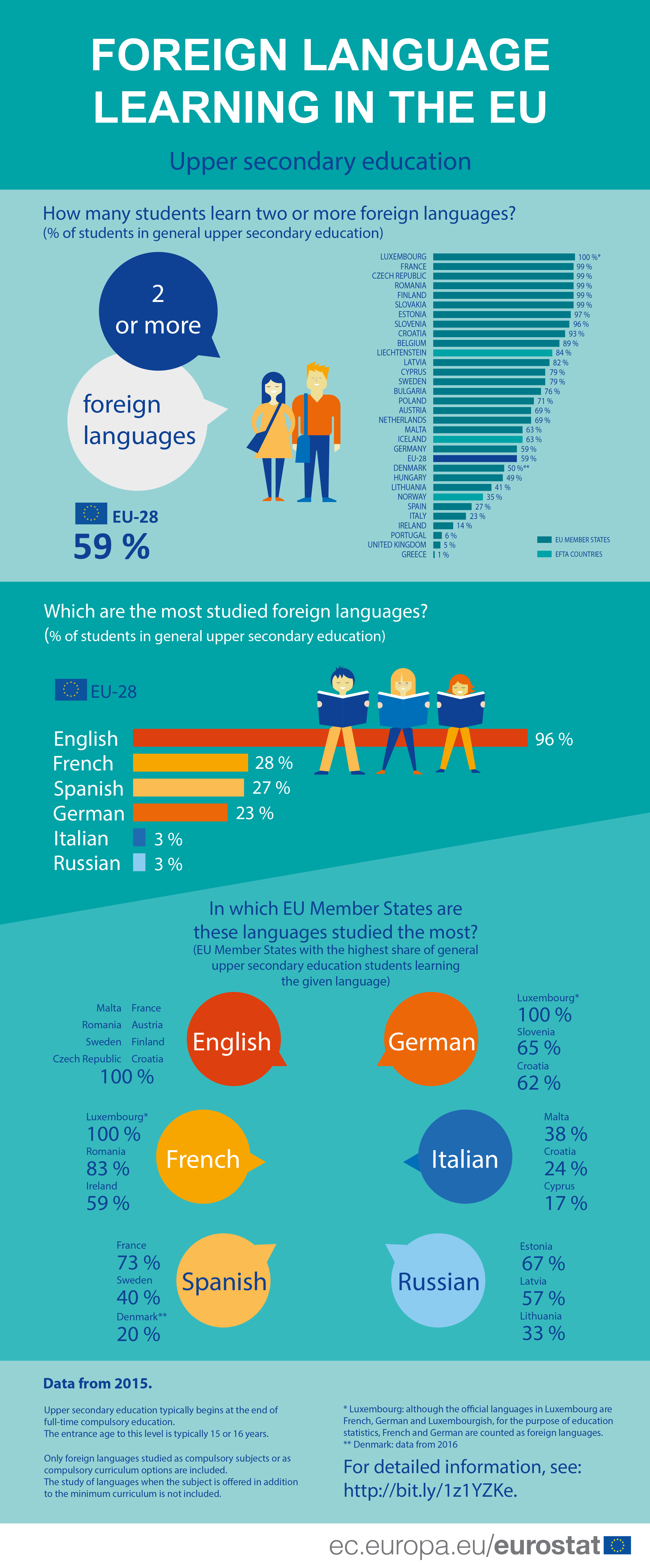
Source: http://ec.europa.eu/eurostat/statistics-explained/index.php/Foreign_language_learning_statistics
Data extracted in January 2016. Most recent data: Further Eurostat information, Main tables and Database. Planned article update: January 2017.