Chinese University of Hong Kong, 23 June 2026

Abstract
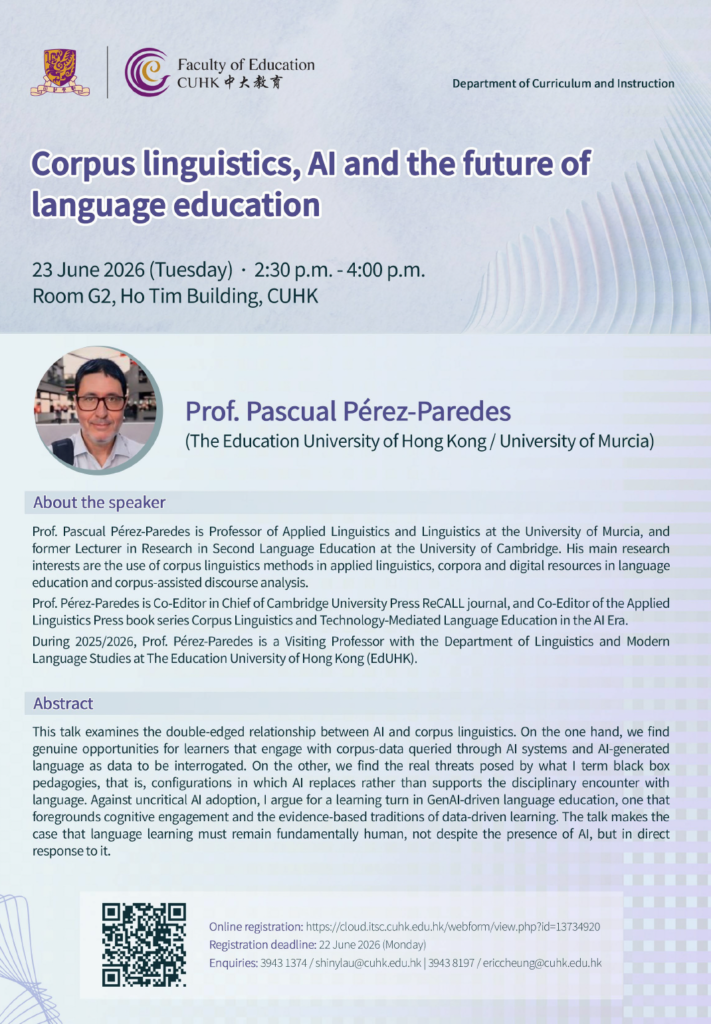
This talk examines the double-edged relationship between AI and corpus linguistics. On the one hand, we find genuine opportunities for learners that engage with corpus-data queried through AI systems and AI-generated language as data to be interrogated. On the other, we find the real threats posed by what I term black box pedagogies, that is, configurations in which AI replaces rather than supports the disciplinary encounter with language. Against uncritical AI adoption, I argue for a learning turn in GenAI-driven language education, one that foregrounds cognitive engagement and the evidence-based traditions of data-driven learning. The talk makes the case that language learning must remain fundamentally human, not despite the presence of AI, but in direct response to it.
References
Bearman, M., & Ajjawi, R. (2023). Learning to work with the black box: Pedagogy for a world with artificial intelligence. British Journal of Educational Technology, 54(5), 1160–1173. https://doi.org/10.1111/bjet.13337
Cheung, L., & Crosthwaite, P. (2025). CorpusChat: integrating corpus linguistics and generative AI for academic writing development. Computer Assisted Language Learning, 1-27.
Crompton, H., Edmett, A., Ichaporia, N., & Burke, D. (2024). AI and English language teaching: Affordances and challenges. British Journal of Educational Technology, 55(6), 2503–2529. https://doi.org/10.1111/bjet.13460
Curry, N., McEnery, T., & Brookes, G. (2025). A question of alignment – AI, GenAI and applied linguistics. Annual Review of Applied Linguistics, 45, 315–336. doi:10.1017/S0267190525000017
Cuskley, C., Woods, R., & Flaherty, M. (2024). The Limitations of Large Language Models for Understanding Human Language and Cognition. Open Mind, 8, 1058–1083. https://doi.org/10.1162/opmi_a_00160
Eaton, S.E. Postplagiarism: transdisciplinary ethics and integrity in the age of artificial intelligence and neurotechnology. Int Journal Education Integrety 19, 23 (2023). https://doi.org/10.1007/s40979-023-00144-1
Fang, S., & Han, Z. (2025). On the nascency of ChatGPT in foreign language teaching and learning. AnnualReviewofAppliedLinguistics, 45, 148–178. doi:10.1017/S026719052510010X
Han, Z. (2024). Chatgpt in and for second language acquisition: A call for systematic research. Studies in Second Language Acquisition, 46(2), 301-306.
Handley, Z. L. (2024). Has artificial intelligence rendered language teaching obsolete?. The Modern Language Journal.
Kern, R. (2021). Twenty-five years of digital literacies in CALL. Language, Learning & Technology.
Kern, R. (2024). Twenty-first century technologies and language education: Charting a path forward. Modern Language Journal, 108, 515–533. https://doi.org/10.1111/modl.12924
Kern, R. (2025). New Literacies: A Historical Perspective. In The Palgrave Encyclopedia of Computer-Assisted Language Learning (pp. 1-5). Springer Nature Switzerland.
Lawrence, N. (2024). The Atomic Human .Understanding Ourselves in the Age of AI. Penguin.
Lévy, P. (2025). Symbolism, digital Culture and Artificial Intelligence. RED. Revista de Educación a Distancia, 25(81). http://dx.doi.org/10.6018/red.630211
Luo, N., Wang, Y., Zhang, Z. (Victor), Zhou, Y., & Zhao, R. (2025). Impact of prompt sophistication on ChatGPT’s output for automated written corrective feedback. ReCALL, 1–15. https://doi:10.1017/S095834402510044X
McEnery, T. (2025). Twenty years of Corpora. Corpora, 20(1), 1-2.
McInnes, R. (2025, April 11). Resist the gen-AI-driven university: A call for reclaiming thought in learning and teaching. ASCILITE TELall Blog. https://blog.ascilite.org/resist-the-gen-ai-driven-university-a-call-for-reclaiming-thought-in-learning-and-teaching/
Miller De Rutté, A., & Correa, M. (2026). Evaluating GPT-generated feedback for beginning-level Spanish writing: An exploratory study. ReCALL, 1–17. https://doi:10.1017/S0958344026100469
Mizumoto, A. (2023). Data-driven learning meets generative AI: Introducing the framework of metacognitive resource use. Applied Corpus Linguistics, 3(3), 100074.
Ohashi, L., & Alm, A. (2025). Conversational AI Literacy. In The Palgrave Encyclopedia of Computer-Assisted Language Learning (pp. 1-6). Cham: Springer Nature.
The Open University. (2025). A framework for the learning and teaching of critical AI literacy skills. https://www.open.ac.uk/blogs/learning-design/wp-content/uploads/2025/01/OU-Critical-AI-Literacy-framework-2025-external-sharing.pdf
Pérez-Paredes, P. (2026). Corpus linguistics and AI in the reconfiguration of language learning ecologies. Language Teaching, 1–13.doi:10.1017/S0261444825101109
Pérez-Paredes, P. & Ma, Q. (forthcoming). GenAI and language teacher education: Rethinking the future of language learning. In Tafazoli, D. & Ledger, S. (Eds.). The Cambridge Handbook of Artificial Intelligence and Language Teacher Education. Cambridge University Press.
Pérez-Paredes, P. (forthcoming). GenAI use in university language learning: from opacity and black box pedagogies to reclaiming disciplinary values. In Digital Horizons in Language and Translation Studies. Peter Lang.
Pérez-Paredes, P. (2027). Corpora and Artificial Intelligence: Reimagining Language Teaching. Routledge.
Pérez-Paredes, P. & Boulton, A. (2025). Data-driven Learning in and out of the Language Classroom. Cambridge University Press. https://doi.org/10.1017/9781009511384
Pérez-Paredes, P. Curry, N. & Aguado Jiménez, P. (2025). Integrating critical corpus and AI literacies in applied linguistics: a mixed-methods study. Computer Assisted Language Learning. https://doi.org/10.1080/09588221.2025.2569351
Pegrum, M. (2026). From revolution to evolution: What generative AI really means for language learning. Language Teaching, 59(2), 180–196. doi:10.1017/S0261444825000151
Rhodes, C., & Linnenluecke, M. K. (2025). The junkification of research. https://opus.lib.uts.edu.au/bitstream/10453/190664/3/The%20Junkification%20of%20Research.pdf
Russell, S. (2019). Human compatible: AI and the problem of control. Penguin.
Seargeant, P. (2023). The future of language. Bloomsbury.
Stockwell, G. (2024). ChatGPT in language teaching and learning: Exploring the road we’re travelling. Technology in Language Teaching & Learning, 6(1), 2273. https://doi.org/10.29140/tltl.v6n1.2273
Son, J. B., Ružić, N. K., & Philpott, A. (2025). Artificial intelligence technologies and applications for language learning and teaching. Journal of China Computer-Assisted Language Learning, 5(1), 94-112
Sutoris, P. (2025, May 21). Our future may depend on the humanities. Wonkhe. https://wonkhe.com/blogs/our-future-may-depend-on-the-humanities/
Wegerif, R. (2026). Towards a new AI curriculum. Substack. https://rupertwegerif.substack.com/p/towards-a-new-ai-curriculum
Wegerif, R., & Casebourne, I. (2025). A dialogic theoretical foundation for integrating generative AI into pedagogical design. British Journal of Educational Technology, 57(3), 639–654. https://doi.org/10.1111/bjet.70026
Wu, T.-T., Hapsari, I. P., & Huang, Y.-M. (2026). Intelligent chatbot–supported collaborative learning: Impact on student engagement and English speaking skills. ReCALL, 1–19. doi:10.1017/S0958344025100451
Zou, M., Reinders, H., & Amjad, F. (2026). Understanding the potential role of GenAI-mediated informal digital learning of English (GenAI-IDLE) in the Global South: AI literacy, emotions, and willingness to communicate as outcomes. ReCALL, 38(1), 131–149. doi:10.1017/S0958344025100360
Zou, D., Xie, H., & Kohnke, L. (2025). Navigating the future: Establishing a framework for educators’ pedagogic artificial intelligence competence. European Journal of Education. https://doi.org/10.1111/ejed.70117
Short bio
Pascual Pérez-Paredes is Professor of Applied Linguistics and Linguistics at the University of Murcia, and former Lecturer in Research in Second Language Education at the University of Cambridge. His main research interests are the use of corpus linguistics methods in applied linguistics, corpora and digital resources in language education and corpus-assisted discourse analysis.
Pascual is Co-Editor in Chief of Cambridge University Press ReCALL journal, and Co-Editor or the Applied Linguistics Press book series Corpus Linguistics and Technology-Mediated Language Education in the AI Era.