Guest talk.
July 7, 2026, 13:00 (UK time)
Lancaster University. Linguistics & English Language.
Residential 2026: AI in Applied Linguistics
Abstract
This talk explores linguistic variation in public-oriented research communication, focusing on academic news blog posts from The Conversation discussing the climate crisis. Employing multidimensional analysis (MDA) and cluster analysis within a corpus linguistics framework, the talk identifies four distinct text types: rhetorical narratives, reasoned abstractions, empirical storytelling, and quantitative reflections. These categories reveal diverse approaches scholars use to engage non-specialist audiences, balancing scientific accuracy with accessibility and engagement. The findings contribute to an in-depth understanding about register variation in digital science communication, emphasizing its role in fostering public engagement with complex scientific issues.
The talk underscores the importance of human-led research methods and the need for a methodological blueprint for analysing register variation in interdisciplinary, subject-specific academic texts aimed at wider audiences.
This talk is based on
Curry, N., & Pérez-Paredes, P. (2025). Exploring public-oriented research communication. Register Studies, 7(1), 99–129. https://doi.org/10.1075/rs.25008.cur
Short bio
I am a Professor of Applied Linguistics and Linguistics, U. Murcia, Spain, and former Lecturer in Research in Second Language Education at the University of Cambridge. My main research interests are the use of corpus linguistics methods in applied linguistics, corpora and digital resources in language education and corpus-assisted discourse analysis. I am Co-Editor in Chief of CUP ReCALL journal (5.7 IF 2024; ranked 4th in Linguistics) and Assistant Editor of TESOL Quaterly. I’m a member of the Applied Linguistics Press (ALP) Advisory Board and the Inter-Varietal Applied Corpus Studies (IVACS) Advisory Board, among other journals and associations. My most recent books are Data-driven Learning in and out of the Language Classroom, Cambridge University Press, co-authored with Prof Alex Boulton, and Corpus linguistics for language learning research, published in the John Benjamins Research Methods in Applied Linguistics (RMAL) series with co-authors Gel Mark and Anne O’Keeffe. I am currently PI of the Spanish Research Agency-funded project.
The 2026 PhD residential
The PhD in Linguistics by Thesis and Coursework programme at Lancaster University is
pleased to present the 2026 PhD Residential. This year, the residential is organised by Aysha
Altamimi, Citra Suryanovika, and Hind Alshahrani, in collaboration with the programme lead,
Sebastian Muth.
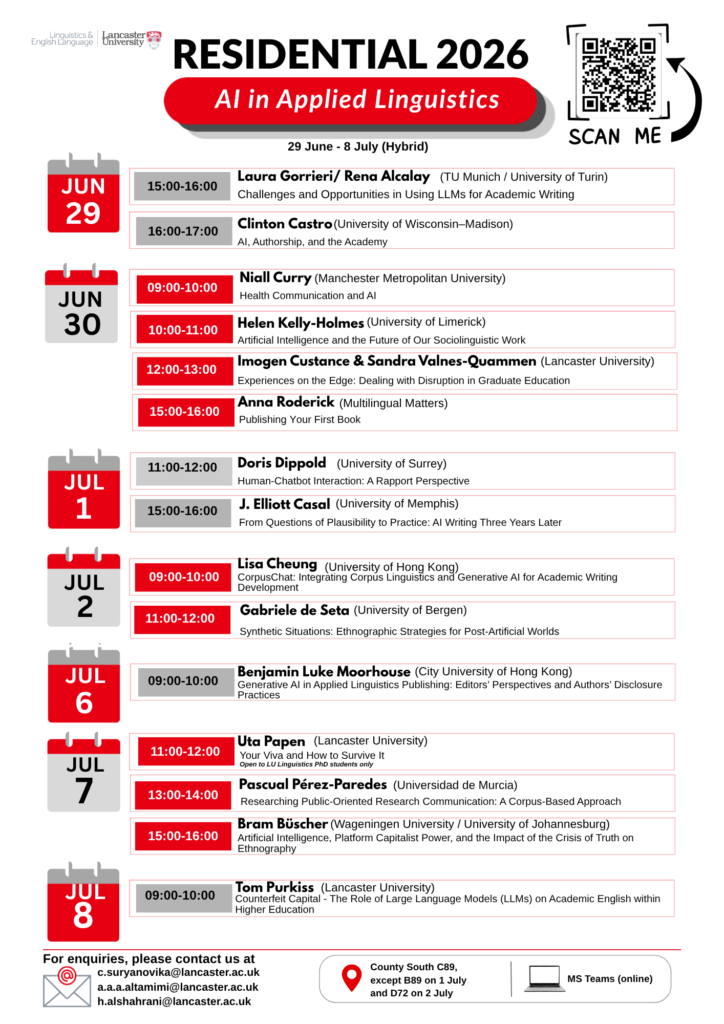
The 2026 Residential runs from 29 June to 8 July 2026 and includes a welcome session,
invited talks and discussions, workshops, a peer review experience-sharing session and PhD
student presentations. We will meet on campus and online via Teams. Details of the invited
talks are provided below.
The 2026 PhD residential brings together researchers working across applied linguistics, discourse
studies, sociolinguistics, ESOL, language policy and beyond to critically examine the role of artificial intelligence in linguistic research and higher education. As AI tools increasingly shape how knowledge is produced, analysed, taught, and governed, this residential is meant as a space to interrogate and reflect on the epistemological, methodological, and political implications of AI on our field. Through keynote talks, workshops, and collaborative discussion, we will critically explore how AI is reshaping our field — and how we might respond.