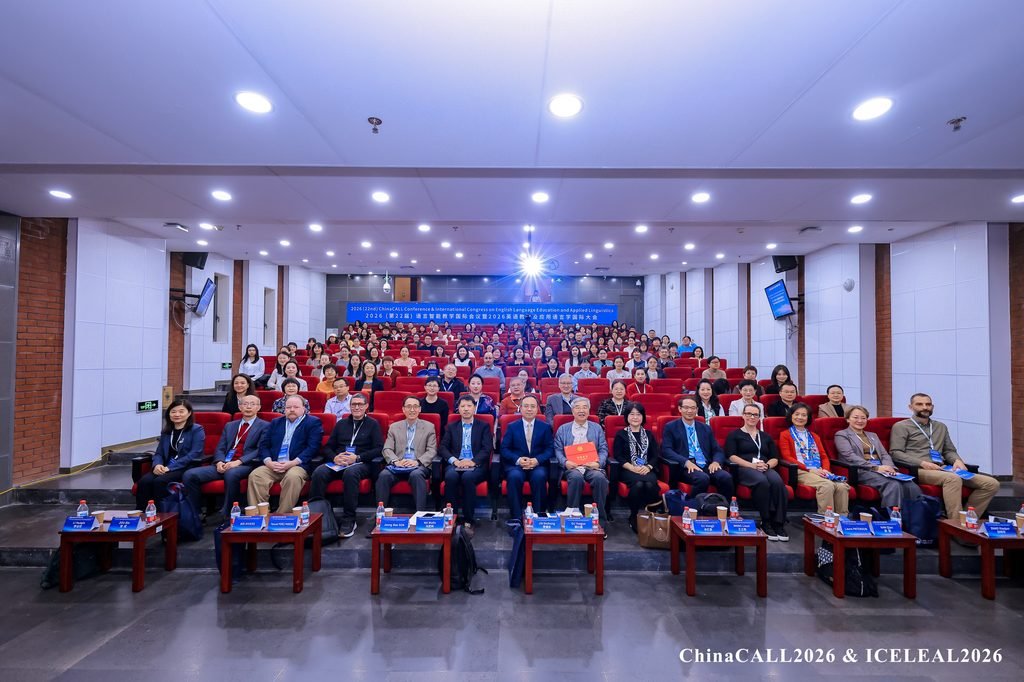
Plenary talk, 15 November 2026
2026 (22nd) ChinaCALL Conference (ChinaCALL 2026) & International Congres on English Language Education and Applied Linguistics (ICELEAL 2026) URL
Some references

Aguado-Jiménez, P. Pérez-Paredes,P. Marín-Pérez, M.J. & Ordoñana-Guillamón, C. (fortcoming). “A longitudinal account of Data-driven learning in the age of AI”. In Vasheghani Farahani, M., Akan, C. & Javdani Esfanhani, S. (Eds.) Data-Driven Language Teaching and Learning: Theory, Research, and Practice. Springer.
Anthony, L. (2025). Integrating AI technology into corpus-based language learning through ChatAI. Computer Assisted Language Learning, 1-19. https://doi.org/10.1080/09588221.2025.2589747
Bernaisch, T. (2026). Corpus linguistics in the age of generative AI: practical and theoretical considerations. Linguistics Vanguard. https://doi.org/10.1515/lingvan-2025-0207
Boulton, A., & Cobb, T. (2017). Corpus Use in Language Learning: A Meta‐Analysis. Language Learning, 67(2), 348-393. https://doi.org/10.1111/lang.12224
Boulton, A., & Vyatkina, N. (2021). Thirty years of data-driven learning: Taking stock and charting new directions over time. Language Learning & Technology, 25(3), 66–89. https://doi.org/10.64152/10125/73450
Boulton, A., & Vyatkina, N. (2024). Expanding methodological approaches in DDL research. Tesol Quarterly, 58(3), 1193-1204. https://doi.org/10.1002/tesq.3269
Chambers, A. (2019). Towards the corpus revolution? Bridging the research–practice gap. Language Teaching, 52(4), 460-475.
Cheung, L., & Crosthwaite, P. (2025). CorpusChat: integrating corpus linguistics and generative AI for academic writing development. Computer Assisted Language Learning, 1-27. https://doi.org/10.1080/09588221.2025.2506480
Crosthwaite, P., & Özer, M. (2026). Vibecoding as method: A structured workflow for AI-assisted research instrument development in applied linguistics. Research Methods in Applied Linguistics, 5(3), 100356. https://doi.org/10.1016/j.rmal.2026.100356
Curry, N., & McEnery, T. (2025). Corpus linguistics for language teaching and learning: A research agenda. Language Teaching,
58(2), 232–251. https://doi.org/10.1017/S0261444824000430
Curry, N., McEnery, T., & Brookes, G. (2025). A question of alignment – AI, GenAI and applied linguistics. Annual Review of Applied Linguistics, 45, 315–336. doi:10.1017/S0267190525000017
Cuskley, C., Woods, R., & Flaherty, M. (2024). The Limitations of Large Language Models for Understanding Human Language and Cognition. Open Mind, 8, 1058–1083. https://doi.org/10.1162/opmi_a_00160
Forti, L. (2023). Corpus use in Italian language pedagogy: Exploring the effects of data-driven learning. Routledge.
Godwin-Jones, R. (2017). Data-informed language learning. Language Learning & Technology, 21(3), 9–27.
Godwin-Jones, R. (2020). Building the porous classroom: An expanded model for blended language learning. Language Learning & Technology, 24(3), 1–18. http://hdl.handle.net/10125/44731
Hou, Z., & Min, S. (2026). Dialogue-based computer-assisted language learning systems for second language speaking development: A three-level meta-analysis. ReCALL, 38(1), 40–56. https://doi.org/10.1017/S0958344025100268
Johns, T. F. (1991a). Should you be persuaded: Two samples of data-driven learning materials. ELR Journal, 4, 1–16.
Johns, T. F. (1991b). Data-driven learning and the revival of grammar. Eurocall (pre-conference booklet, pp. 20–21). 21–23 August, Finland.
Johns, T. F. (1991c). From printout to handout: Grammar and vocabulary teaching in the context of data-driven learning. ELR Journal, 4, 27–45.
Jurafsky, D. and Martin, J. H. (2026). Speech and Language Processing: An Introduction to Natural Language Processing, Computational Linguistics, and Speech Recognition with Language Models, 3rd edition. Online manuscript released January 6, 2026. https://web.stanford.edu/~jurafsky/slp3.
Kern, R. (2021). Twenty-five years of digital literacies in CALL. Language Learning & Technology, 25(3), 132–150. https://doi.org/10.64152/10125/73453
Lawrence, N. (2024). The Atomic Human .Understanding Ourselves in the Age of AI. Penguin.
Lee, T. & Egbert, J. (2026). Artificial meaning? 77 Fla. L. Rev. 2235. Available at: https://scholarship.law.ufl.edu/flr/vol77/iss6/10
Lévy, P. (2025). Symbolism, digital Culture and Artificial Intelligence. RED. Revista de Educación a Distancia, 25(81). http://dx.doi.org/10.6018/red.630211
Li, M., Wang, Y., & Yang, X. (2025). Can Generative AI chatbots promote Second Language Acquisition? A meta‐analysis. Journal of Computer Assisted Learning, 41(4). https://doi.org/10.1111/jcal.70060
Ma, Q., Mei, F., Crosthwaite, P., & Ma, X. (2026). Combining AI and Corpus Technology in Language Teaching: Professional Development and Knowledge Co-Construction Using the CoI Framework. Computers & Education, 105728. https://doi.org/10.1016/j.compedu.2026.105728
Ma, Q., Yan, J., Crosthwaite, P., & Lee, C. K. J. (2026). TPACK for corpus technology: TESOL student teachers’ growth and self-efficacy in independent language learning and teaching. ReCALL, 38(1), 94-110. https://doi:10.1017/S0958344025100347
McEnery, T. (2025). Twenty years of Corpora. Corpora, 20(1), 1-2.
McEnery, T., & Brezina, V. (2022). Fundamental Principles of Corpus Linguistics. Cambridge University Press. https://doi.org/10.1017/9781107110625
Mizumoto, A. (2023). Data-driven learning meets generative AI: Introducing the framework of metacognitive resource use. Applied Corpus Linguistics, 3(3), 100074. https://doi.org/10.1016/j.acorp.2023.100074
Pérez-Paredes, P. (2026). Corpus linguistics and AI in the reconfiguration of language learning ecologies. Language Teaching, 1–13. https://doi:10.1017/S0261444825101109
Pérez-Paredes, P. (forthcoming). GenAI use in university language learning: from opacity and black box pedagogies to reclaiming disciplinary values. In Digital Horizons in Language and Translation Studies. Peter Lang.
Pérez-Paredes, P. & Boulton, A. (2025). Data-driven Learning in and out of the Language Classroom. Cambridge University Press. https://doi.org/10.1017/9781009511384
Pérez-Paredes, P. Curry, N. & Aguado Jiménez, P. (2025). Integrating critical corpus and AI literacies in applied linguistics: a mixed-methods study. Computer Assisted Language Learning, 1-27. https://doi.org/10.1080/09588221.2025.2569351
Pérez-Paredes, P. Curry, N. & Ordoñana-Guillamón, C. (2025). Critical AI literacy for applied linguistics and language education students. Journal of China Computer-Assisted Language Learning (JCCALL), 5(2),175-214 doi.org/10.1515/jccall-2025-0005 URL.
Pérez-Paredes, P. & Ordoñana-Guillamón, C. (2025). Future challenges and opportunities for data-driven learning. In McCallum, L. & Tafazoli, D. (Eds.) The Palgrave Encyclopedia of Computer-Assisted Language Learning. Springer. https://doi.org/10.1007/978-3-031-51447-0_350-1
Raff, E., Farris, D.,Biderman, S. & Hamilton, B.A. (2025). How Large Language Models Work. Manning.
Russell, S. (2019). Human compatible: AI and the problem of control. Penguin.
Sinclair, J. (1991). Corpus, concordance, collocation. Oxford University Press.
Stewart, D. (2025). Lost in the forest: Flashpoints for language learners in sketch engine. Iperstoria, 25, 527–554. https://doi.org/10.13136/2281-4582/2025.i25.1585
Wegerif, R., & Casebourne, I. (2025). A dialogic theoretical foundation for integrating generative AI into pedagogical design. British Journal of Educational Technology, 57(3), 639–654. https://doi.org/10.1111/bjet.70026