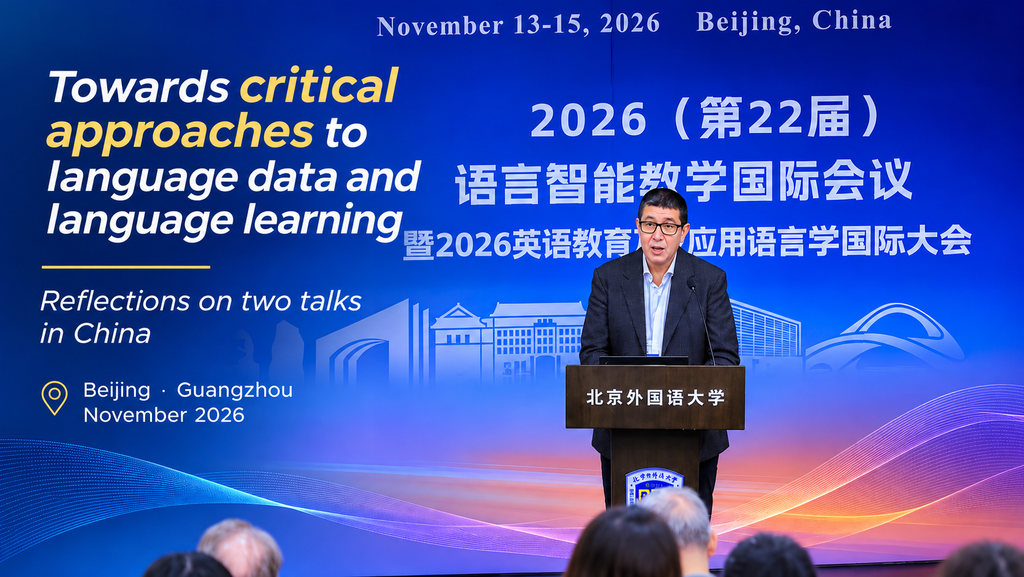
Beijing and Guangzhou, November 2026
Over the past few days, I have had the opportunity to discuss the future of corpus linguistics and language education in the AI era in two academic settings in China: Beijing Foreign Studies University (BFSU), where I delivered a plenary at ChinaCALL 2026 on 15 November, and the School of Foreign Studies at South China Normal University (SCNU), Guangzhou, on 17 November.
Delivering these two talks within such a short period offered an opportunity to revisit some of my own assumptions about the convergence of corpus linguistics, generative AI and language education.
Friction and synergy
One of the central tensions underlying both talks concerns the quality of language learning and how we conceptualize language learning at this point in time.
Generative AI has reduced the effort required to produce and manipulate language data. Yet reducing friction is not necessarily synonymous with improving learning. Much of the educational value of DDL has traditionally resided in the intellectual effort involved in exploring data, identifying patterns, formulating hypotheses and questioning initial interpretations. This is the ethos of DDL. Should we be concerned that some of these intellectual practices are increasingly being delegated to AI?
Perhaps one of the limitations of our current discussions about AI in language education is that we tend to foreground what technology enables while paying insufficient attention to what it may displace.
Revisiting the role of corpus linguistics
Both presentations invited me to reconsider whether corpus linguistics should be understood simply as a complementary resource in AI mediated learning environments.
I’d argue that its contribution is deeper. Corpus linguistics offers an epistemological framework through which learners can interrogate language, examine the origin of language data and critically assess the claims made by generative systems.
However, we should not romanticise corpus pedagogy either. Corpora are selective representations of language use, shaped by decisions about sampling, representation and categorisation. Their educational value depends on how critically these decisions are understood.
The challenge for us, for humans I mean, is not to establish a hierarchy between corpus data and AI generated data, but to develop pedagogies that encourage learners to interrogate both.
Black box and open box pedagogies
Looking back at the two presentations, I think that the notion of open box pedagogies deserves further theoretical and empirical attention.
How can we design learning experiences in which students remain intellectually engaged with language data rather than becoming passive consumers of technologically mediated explanations?
How can we assess whether AI supports the development of linguistic knowledge or merely improves the quality of the immediate task output?
These questions are particularly relevant to our ongoing work within the BsDDL project and our research into critical corpus and AI literacies.
The notion of open box pedagogies should not remain an attractive metaphor. It needs to translate into classroom practices, assessment criteria and research designs that allow us to examine learner agency, cognitive engagement and the transfer of learning across tasks and over time.
Looking ahead
My two talks in China have provided an opportunity to reconsider the direction of my own research and the broader agenda of DDL in an era of increasingly pervasive AI.
I remain optimistic about the convergence of corpus linguistics and AI, but this optimism needs to be accompanied by disciplinary rigour and a willingness to question assumptions about technological innovation.
Ultimately, the future of corpus pedagogy may depend less on its capacity to incorporate AI than on its capacity to offer something that AI alone cannot guarantee, that is, a critical and intellectually engaged approach to language learning.
The question is no longer simply how we can use AI to teach languages, but what kind of language learners we want to educate in societies increasingly mediated by AI.
My sincere thanks to colleagues at BFSU and SCNU for their invitation and hospitality.